

Awareness of the importance of indoor air quality has increased greatly in recent years. Many people are now concerned with the knowledge that building materials, furniture and conventional paints can release pollutants into our family homes. It’s not yet widely known that you can apply a paint product which will actively counteract pollutants in your living space.
Anti pollution paint, also known as air purifying paint is a specialist mineral paint designed to help improve indoor air quality by reducing airborne pollutants. Some formulations can absorb carbon dioxide during curing, while others use photocatalytic technology to break down harmful gases.
 Interested? Let’s take a look at how anti pollution paint actively cleans the air in your home, how it makes a difference, and which paints we stock that can offer air purifying properties.
What Is Anti Pollution Paint?
Anti pollution paints are specialist coatings designed to help reduce pollutants in the air within a room. The paints are usually mineral based, often using lime as a key ingredient, and incorporate technologies that actively interact with and neutralise airborne pollutants like formaldehyde and VOCs.
They absorb carbon dioxide during curing and use light-activated minerals to continuously break down indoor pollutants such as VOCs and formaldehyde whenever the painted surface is exposed to light.
Depending on the formulation, these paints can:
- Absorb carbon dioxide during the natural curing process of lime.
- Continuously break down airborne pollutants such as nitrogen oxides, VOCs and formaldehyde when exposed to light.
- Help reduce odours by breaking down the compounds that cause them.
- Support breathable wall systems that help regulate moisture.
These paints won’t replace good ventilation or air filtration, but they can help lower the overall level of pollutants in a room.
How Does Air Purifying Paint Work?
There are two main technologies behind modern anti-pollution paints. Both are based on mineral paint systems rather than synthetic emulsions.
CO2 Absorbing Lime Paints
Lime based paints cure through a process known as carbonation. During this reaction the lime binder slowly reacts with carbon dioxide in the air and converts back into calcium carbonate.
This natural chemical process means that lime paints can absorb measurable amounts of CO2 while they cure. In practical terms, a large quantity of lime paint applied across walls and ceilings can absorb several kilograms of carbon dioxide as it hardens.
This helps offset part of the paint’s overall carbon footprint and is one reason lime paints are often chosen for more environmentally conscious projects.
Photocatalytic Pollution Absorbing Paints
Some advanced mineral paints also contain photocatalytic ingredients such as titanium dioxide. When exposed to light, these ingredients trigger chemical reactions that break down certain pollutants.
This photocatalytic process can help decompose compounds including:
- Nitrogen oxides (NOx).
- Volatile organic compounds (VOCs).
- Formaldehyde.
- Certain odour causing molecules.
Some formulations are active under both natural daylight and indoor lighting, allowing the effect to continue in normal living conditions.
Many indoor materials release VOCs over time. These emissions are often low level but continuous, which means they can build up in poorly ventilated spaces.
What Causes Indoor Air Pollution?
Indoor air pollution is often a mix of everyday activities and materials within the home. While some sources can be reduced or removed, others are built into the structure of the building or release pollutants slowly over time.
The most significant contributors include:
- Building materials – Materials such as MDF, insulation, paints and sealants can release pollutants like formaldehyde and other VOCs for months or even years.
- Furniture – Chipboard furniture, cabinetry and soft furnishings often contain glues and treatments that off gas into the air over time.
- Combustion gases – Cooking, gas hobs, wood burners and heating systems can release gases such as carbon monoxide and nitrogen dioxide.
- Flooring and finishes – Vinyl flooring, laminates, carpets and adhesives can emit VOCs from synthetic backings and bonding agents.
- Radon – A naturally occurring gas that can enter buildings from the ground, particularly in certain areas of the UK.
- Moisture and mould – Damp conditions allow mould to grow, releasing spores into the air that can irritate the lungs.
- Dust mites and pet dander – Common biological pollutants that build up in fabrics, carpets and soft furnishings.
Even in well maintained homes, many of these sources cannot be completely removed. This is why ventilation, material choice and low emission finishes all play an important role in maintaining good indoor air quality.
Does Anti Pollution Paint Work?
Research suggests that photocatalytic mineral coatings can break down certain pollutants when exposed to light.
Lime based paints also offer several additional benefits that support healthy buildings:
- Extremely high breathability.
- Alkaline surfaces that discourage mould growth.
- Very low VOC levels.
- Mineral based raw materials.
Not all anti-pollution paints work in the same way. Some rely on lime carbonation, while others use photocatalytic minerals to break down pollutants under light.
Our Recommended Air Purifying Paints
We stock two air purifying paints that we rate highly for effectiveness. These are products with clearly defined mineral formulations and well understood technologies, so you know exactly how they work and what to expect.

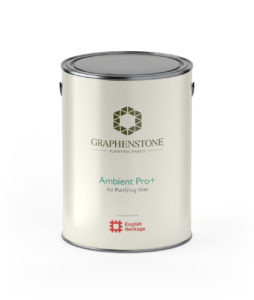
Graphenstone Ambient Pro – Advanced Photocatalytic Anti Pollution Paint
One of the most advanced anti pollution paints currently available is Graphenstone Ambient Pro. This lime based mineral paint combines natural carbonation with photocatalytic technology. Ambient Pro uses a formulation based on handmade lime combined with Graphenstone technology. The paint is designed to reduce pollutants in the air while also providing a durable decorative finish.
When exposed to light, the coating helps decompose several common airborne pollutants including nitrogen oxides, volatile organic compounds, carbon monoxide and formaldehyde. During the curing process the lime binder also absorbs carbon dioxide from the surrounding air. According to manufacturer testing, around 5 kg of CO2 can be absorbed for every 15 litres of paint applied.
The paint is also extremely breathable, with a water vapour permeability sd value of approximately 0.05 metres. This allows moisture vapour to pass through the coating easily, helping prevent condensation within walls. Ambient Pro is suitable for both interior and exterior surfaces and is certified under several environmental schemes including Cradle to Cradle certification.
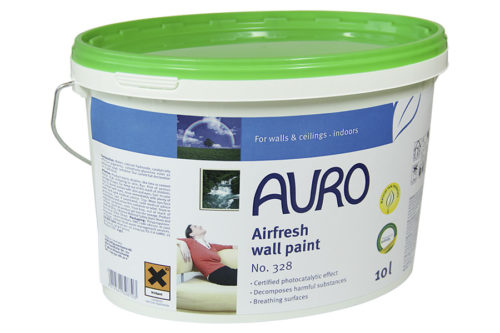
AURO Airfresh Wall Paint No. 328 – Mineral Air Purifying Paint
Another effective anti pollution paint is AURO Airfresh Wall Paint No. 328. This paint is based on lime and mineral fillers and uses titanium dioxide to create a photocatalytic effect. The coating helps reduce certain organic compounds in indoor air while maintaining the benefits of a fully mineral paint system.
Airfresh wall paint is highly vapour permeable with an sd value below 0.05 metres, making it suitable for breathable wall systems such as lime plaster and clay finishes. The paint is also completely free from synthetic dispersion binders and contains no VOCs, making it a popular option for natural building projects. Its mineral composition creates a matt lime finish while supporting a healthy indoor environment.
Explore Air Purifying Paints
Anti pollution paints represent an exciting development in sustainable building materials. By combining mineral paint technology with photocatalytic reactions, these coatings can help reduce pollutants within indoor environments.
If you would like to explore this type of paint further, you can view the full range of air purifying paints available at Organic Natural Paint. Need more info about this type of paint? Contact us. One of our team of experts will be delighted to help.